GDPR Privacy Statement

By the new GDPR law, I am required to make you read the Silly Privacy Statement. That statement doesn't really contain anything unexpected or surprising to people used to the internet, but by accessing and reading this blog you agree that you've read these statements and agree to how this blog uses your data.

On a related topic: If you say something to somebody else, the brain of that person might store the information you told him/her not anonymized and without your explicit consent and use it against you at a later time, and if you leave your house people just might see where you go and what you do.

Friday, 8 October 2021

Book IV ~ Bonus Chapter Part 1 ~ Trawling to Thuringia

26-Sep-2021

We’ve been to the easternmost point of Germany! (see Book IV ~ Chapter 4 ~ Görlitz Gaiety ~ Eastern Escapades)


We’ve been to the northernmost point of Germany! (see Book IV ~ Chapter 8 ~ Sylt Stray Sillyness)


We’ve been to the westernmost point of Germany! (see Book IV ~ Chapter 12 ~ Greenbelt Grounds of Geilenkirchen)
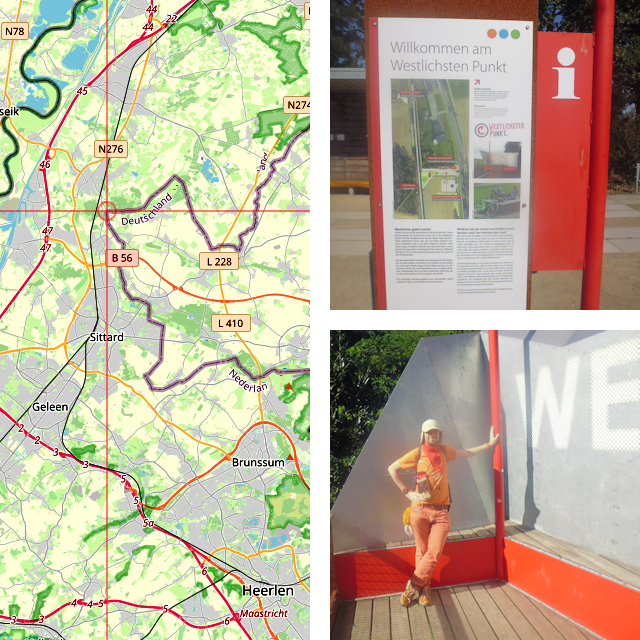

And we’ve also been to the southernmost point of Germany! (see Book IV ~ Extra Chapter ~ The Heroic Haldenwang Hike)


But where haven’t we been yet? That's right! The very centre of Germany is still missing!


However, unlike with the four cardinal points, which are quite clearly defined, the question is how do you determine the centre of a such complex shape as a country like Germany? Now, the good news is that some smart people have already mulled this over… while the bad news is that they all come to different conclusions. As such, there is not only one centre point of Germany, but, in fact, ten of them. For example, you can put all of Germany in a rectangle made of meridians and parallels and then take the centre of that, you could connect the eastern- and westernmost points as well as the northern- and southernmost ones and take the place where those lines intersect, you could take an inner circle or an outer circle, you could make a cardboard model and take the point of balance, and so on and so forth.
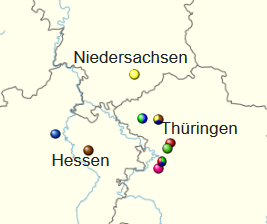

Going through all of them would result in a trip of about 200km, which is considerably more than Robert and I have time for. However, five of them lie reasonably close to one another for the two of us to cover them on a multi-day hiking tour, and so we decide to depart for Eisenach ("Iron Stream"),from where we can - over the course of a five-day trip - hike through said five centres of Germany before arriving at Mühlhausen ("Mill Housing").


So, that's the plan. Arrangements are soon made, and thus, one morning I set out once again at the crack of dawn onto a new journey. Incidentally, exactly one year ago today was the day when Robert and I returned from our grand tour around Germany (see Book IV ~ Chapter 15 ~ A Harrowing Homerun).


Since its only shortly after 6:30 on a Sunday morning, this time around the Untermenzing station really is devoid of other people, and not even ravens are around to keep me company today.


The S-Bahn arrives shortly. Interestingly this one is one of the rare semi-old trains that I still remember from my childhood days. There is still one older model I remember - white with an orange stripe and brace-like door handles - but that's about it. Unlike some other cities, Munich regularly replaces its trains with newer models.
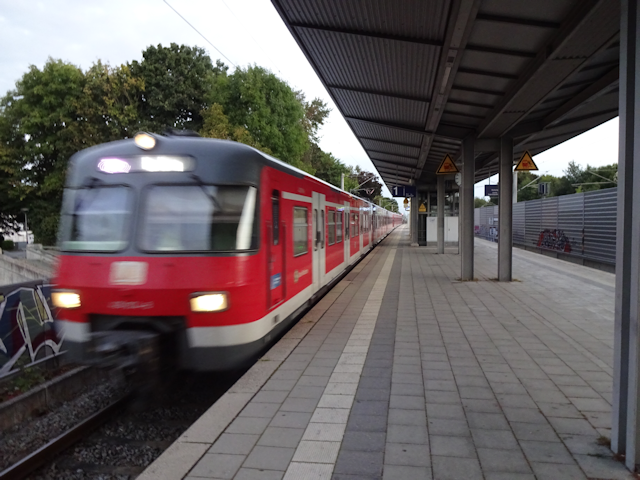

Soon enough, I arrive at the Hauptbahnhof, where I get myself some baked goods for the trip and meet up with Robert. I also take note that the big construction in the main hall that was here the last time around (see Book IV ~ Extra Chapter ~ The Heroic Haldenwang Hike) appears to have finished by now.


And then, we make for our train, a double-deck Regionalexpress that is already waiting for its passengers.


Now, our journey today should be just a little bit roundabout. Since we're headed for the heart of Germany - which ironically is one of its most remote regions - and have once again elected to go there using only regional trains such as to make use of the very affordable Quer-Durchs-Land-Ticket ("Crosswise-Through-The-Country-Ticket"), we are going to travel on a total of five different trains with transfer times as short as 9 minutes. This promises to be exciting. First, we are headed for Nürnberg ("Just a Mountain"), from there to Bamberg ("Bam Mountain"), then onwards to Schweinfurt ("Pig Ford"), onwards to Grimmenthal ("Grim Valley") - where we also cross over into Thuringia - and then finally to Eisenach.


The first leg of our train ride today should at the same time also be the longest, taking us…

Northwards to Nürnberg

Ride Duration: 2:39h
Approximate Distance: 239km
Average Speed: 90km/h

The train to Nürnberg is kinda full, but not too full. I’d say that about half the seats are occupied, which is more than most we’ve seen on our big Germany tour last year I suppose the Green Shnolz really is gradually coming to an end.
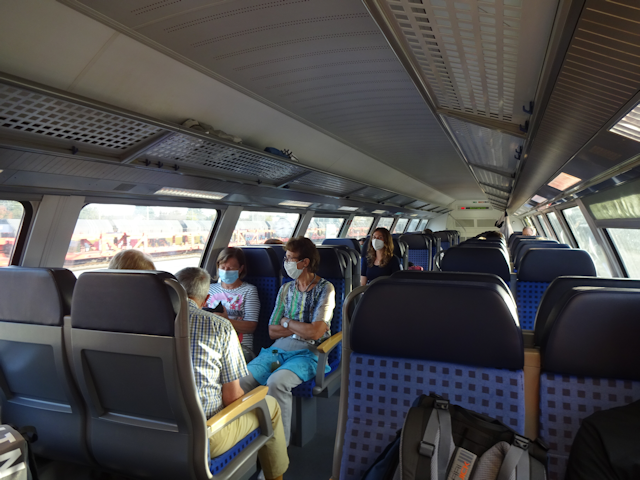

The direct route from Munich to Nürnberg leads pretty much straight north across Ingolstadt (“In Gold City”). However, due to reasons only known to higher powers, our train runs on a slightly more roundabout track, passing such places like Ergoldsbach (“He Gold’s Stream”), Undorf (“Un-Village”) and Neumarkt (“New Market”) along the way. Actually, this makes the first part of the trip the same as the first part of our trip around Germany a year ago (see Book IV ~ Chapter 1 ~ A New Departure), though the tracks diverge at Regnieburg… sorry, at Regensburg.


After leaving Munich behind, we first pass through the flat gravel plains around Munich, before entering the gently rolling hills of Niderbayern (“Lower Bavaria”). Eventually, we cross the mighty Donau after departing from Regensburg, just south of where it is joined by the river Naab (“Nave”). By now, we are in the Oberpfalz (“Upper Palatinate”), where the forests grow somewhat more numerous, and we should remain within this particular region until shortly before Nürnberg, where we then cross over into Mittelfranken (“Middle Franconia”).


We arrive at Nürnberg in time, and with this being the terminus of this train, a lot of people soon crowd the platform in search of wherever it is they need to go.


With over 15 minutes to catch our next train, there's no need for us to rush. However, since this is one of those trains where part of the train is going another way from some station, we're a bit confused about which part to enter at first, especially since the train enters the station the wrong way around. I think that's a typical German thing. At least I never had problems like that in Japan. And in the end, it turns out that it wouldn't have mattered either way, because the stop where we need to get up is still before the one where the train is split, but that, too, was not clearly communicated.
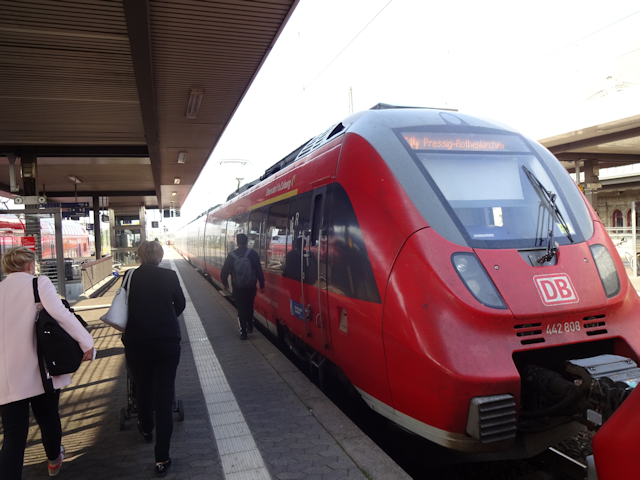

Anyway, with us now safely aboard the right train, we are all set for the next leg which would have us…

Brushing by Bamberg

Ride Duration: 0:40h
Approximate Distance: 63km
Average Speed: 94km/h

This next leg should be significantly shorter. In fact, the ride to Nürnberg is almost as long as all the other four legs of our trip today combined. Along the way we mostly follow the run of the river Regnitz, and with it the northern half of the Rhine–Main–Danube Canal, one of Europe's most important artificial waterways, since it provides direct passage from the North Sea to the Black Sea without having to go all the way around the Iberian Peninsula. We also pass by the towns of Erlangen ("Gain"), Forchheim ("Pine Home") and Hirschaid ("Stag Heath").


Now, this train is maybe a little bit fuller than the last one, but there's still plenty of room for the two of us to find nice seats… and then promptly change them once we realize that the train departs in the other direction.


Along the way, we once again pass mostly by fields and through some forest, though quite possibly due to the fact that we are now more or less following the run of the aforementioned Rhine–Main–Danube Canal, there are somewhat more towns and villages along the way. Also, along the way we come across an interesting piece of track the construction of which is as of yet still in progress. Also, we pass by some typically German Schrebergärten, and halfway along the way cross over into Oberfranken (“Upper Franconia”), which is named that way because it is always halfway up into the Mittelgebirge (“Middle Mountains”) that rim the northern edge of Bavaria.


In Bamberg, too, we arrive with plenty of time to change trains. With over 20 minutes to spare, there's no need to rush. As such, we take our time to notice that this station can do many things: Literature, cooking, trains. Sadly, though, it does not prove to be very responsive to my subsequent order of one Kitsune Udon to go.


Anyway, we shortly arrive on the platform from where our next train is scheduled to depart…
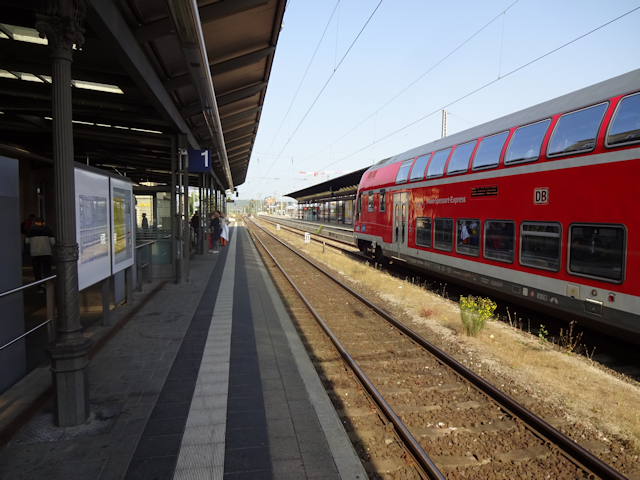

…and soon thereafter the Regionalbahn that will take us towards Schweinfurt arrives to pick us up.


This next leg of our trip should have us follow…

The Meandering Main

Ride Duration: 0:37h
Approximate Distance: 57km
Average Speed: 92km/h

The route to Schweinfurt takes us along the river Main, which at this point is flowing left and right quite freely, and has many small lakes beside it. Though the river itself is barely a hundred meters wide, it still "occupies" a strip about 500m across. Along the way, the train also passes the towns of Gleisenau ("Tracks Meadow"), Haßfurt ("Hare Ford") and Schonungen ("Clemencies").
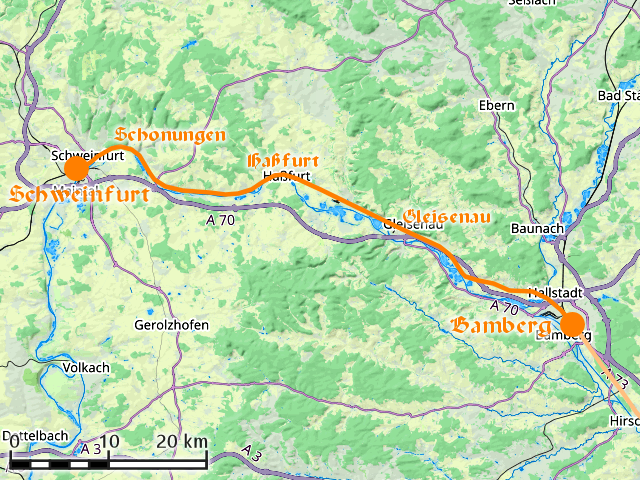

This time around, the train is yet again a little bit more crowded than the last one, and Green-Shnolz-conform seats are becoming a bit of a rarity.


Now, while our route takes us along the Main, I shouldn’t actually get to capture it on video since the entirety of this leg runs along the north bank, and I’m filming out towards the north. Instead, I get to see the hills of the northern bank, the slopes of which are occasionally covered with vineyards – after all, the entirety of Franconia is wine country. Since the summers here are usually quite sunny, that makes the conditions ideal for growing grapes and also all sorts of citrus fruit. In fact, I believe we have passed a lemon orchard right there. Incidentally, we have now also passed from Oberfranken to Unterfranken (“Lower Franconia”) about halfway along this leg.


In Schweinfurt, we only have 12 minutes to change. Fortunately, our train is once again on time (is it just me or are these regional trains significantly more punctual than the long-distance trains?), so we have no trouble getting to the right platform before the train arrives.


The train to Grimmenthal arrives soon after. This one is a Regionalexpress, and appears to be of the same make as the modern S-Bahn of Munich.


With that, we make ourselves comfortable inside the train, as we now should have no more troubles…

Getting to Grimmenthal

Ride Duration: 0:49h
Approximate Distance: 74km
Average Speed: 91km/h

Near the end of this leg, we should cross over from Bayern to Thüringen. Along the way we pass through places such as Ebenhausen ("Flat Housing"), Münnerstadt ("Men City") and befittingly, shortly before passing over into Thüringen, Mellrichstadt ("Girlie Land City").


Again, this train is reasonably full, though maybe a little less so than our last train.


The ride to Grimmenthal takes us mostly lengthwise through a network of shallow valleys housing little streams and small rivers, amongst which is also the Fränkische Saale (“Franconian Halls”). As such, we occasionally pass beneath some bridges of federal road, such as that of the B279 near Herschfeld (“Rule Field”) and the somewhat tall-ish bridge of the B285 just after Mellrichstadt.


In Grimmenthal, we arrive without any delay, which I quite good since this is our shortest transfer, with only 9 minutes to spare. This is made yet more interesting by the fact that the Grimmenthal station features a rather unique design, with our arriving and departing platforms being separated by a stretch of road.


Anyway, we manage to make our connection, and catch a train of the STB (Süd Thüringen Bahn = "South Thuringia Rail"), which like so many trains that are not of the DB is of pretty modern make.


With that, we managed to make our last connection for today, and now can relax and sit back as this last train starts…

Winding the Werra Way

Ride Duration: 1:15h
Approximate Distance: 68km
Average Speed: 54km/h

Our last leg to Eisenach should for the most part leads us along the Werra, which is a river that we should yet encounter later on during this particular journey. Along the way we pass by the towns of Schwallungen ("Onrushings"), Bad Salzungen ("Bath Saltounges") – where we leave the Werra behind – and Marksuhl ("Marrow Wallow"). Also, this time around the train stops at literally every station, so despite this leg being shorter than the one from Schweinfurt, it takes significantly longer.
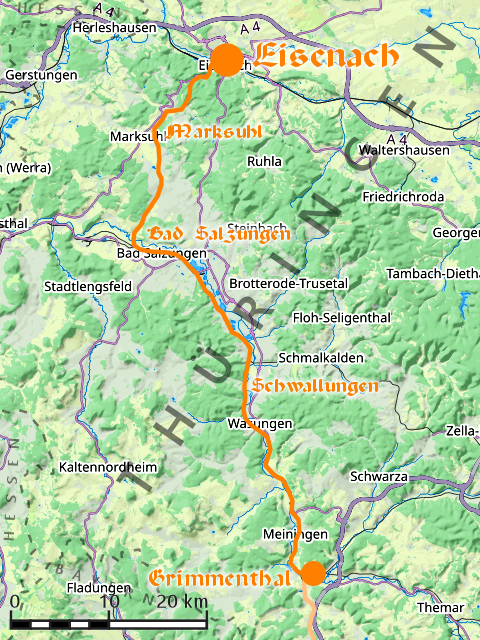

This last train is also the least crowded, with barely a quarter of all seats taken, so we pretty much have free choice of where to sit. In the end, we take a seat near the very front, and yet this train is so short and open that we can see all the way through to the back.


For as long as we stay in the valley of the Werra, the terrain is mostly flat with fields and occasional forests. The Werra itself is mostly hidden from view by a row of trees and bushes, but occasionally we also get to see some of its riverside ponds.Shortly after we cross the Werra – which up here is barely 20m wide – for the last time and subsequently leave it behind, we enter the forested hills to the south of Eisenach, and by the time we emerge from them we are already in the middle of the town.


Finally –, after an array of train ride that took a total of seven hours from start to finish – we arrive at Eisenach. Had we elected to take long-distance trains instead, the whole trip would have lasted only 4 hours instead of 7, however, the price would have been about four times as high as what we paid, so I figure this was worth it. Also, we got to see more of the landscape that way.
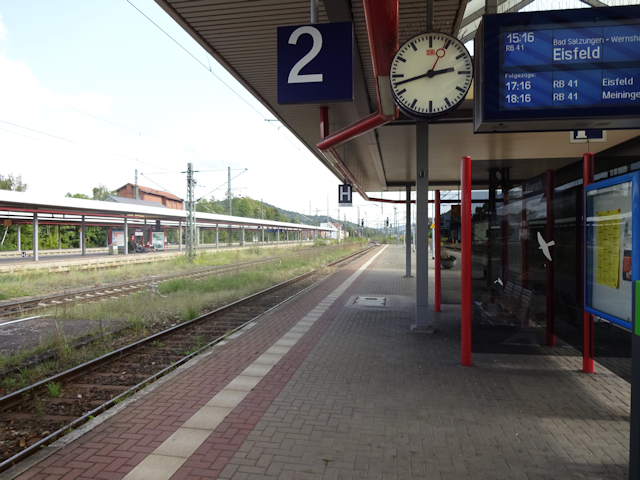

Now, all that remains for us to do is to…

Walk to the Wolfgang

Distance: 2.1km
Ascents: 25m
Duration: 0.5h

Our stay place today is still a few kilometres away from the station, so we need to walk there. Compared to what still lies ahead of us on this journey, this is only a very short distance, and yet with all our luggage on our backs it gives us a first feel of what we have yet to expect. For the most part, we follow the course of the Mühlgraben ("Mill Ditch") – a small stream running through the city that used to power a mill – but near the end we need to walk a bit up the hillside to get to our stay place.


Right outside the station, the town of Eisenach presents itself in a diverse light, with modern buildings starkly contrasting with the old houses, at least along the main street.


The back roads, meanwhile, paint a much more traditional picture of the city.


Our final challenge for this stray should be the Wolfgang, which is not only a typical German given name, but in this case also the name for a somewhat steep road up the hillside. It translates to "Wolf Corridor".


Climbing up the somewhat steep road with all our luggage is quite strenuous. However, in the end, we make it and arrive at our stay place for tonight, the Pension Metilstein.


There, we check in, stow away our luggage in our room, and promptly proceed to go out again. After all, today is still far from over, and we yet want to visit the first of our five targeted centres of Germany. However, the tale of the five centres is one that deserves a chapter of its own, so stay tuned for the next chapter of the Travelling Fox Blog!

Saturday, 4 September 2021

Book IV ~ Epilogue ~ Memories of Home

Over two years have passed since I returned to Germany now, but during that time I have not been idle. Instead, after travelling all around the world, I have now put some effort into getting to know my own home land a little better. Among other things, I have now been to all the cardinal points of Germany, up from the mountains and down to the seas, and while I'm sure there's much I have yet to see, I think this makes this a good time to sit back and take a look on the places I've been to on this last journey in...


Of Germany's 16 states, I have now visited a total of 12 over the course of all my travels in Germany. The ones that still elude me are Niedersachsen ("Sower Saxony"), Brandenburg ("Burning Castle"), Hamburg ("Have Castle") and das Saarland ("The Saar Country"). I'm sure I'll get them eventually, though it may have to be on different journeys, especially since the Saarland is quite a ways away from the other three. Also note that in Germany, only a few states have subdivisions comparable with those of New Zealand and Japan, and the primary subdivisions are on a much smaller level, so I won't be enumerating all of those here.


Including all the travels we did in this book alone, Robert and I have covered about 3,500km on this journey by bus and train, which is considerably less than what I had on my clock in both New Zealand (6,000km) and Japan (10,200km). I suppose the elongated shapes of the two island countries more than compensate for their lack of width - and the fact that all the mountains tend to necessitate zig-zagging tracks probably helps too. However, this is still enough for us to get to from Munich to Lake Inari in Finland on the land route via St. Petersburg.


In addition to that, we did quite a bit of walking and cycling. On this journey alone, we covered over 460km on foot or by bike (roughly a third of which was by bike), and scaled a total of about 5,400m of altitude all the while. Again, this may not be as much as I did in New Zealand (1,620km x 16,500hm) or Japan (1,900km x 21,500hm), but considering we did it in the space of just over three weeks instead of a full year, I still think that's impressive. For reference, that distance would have taken us from Munich to Trier.


Our longest bike ride in terms of both time and distance was the Northermost Ride on Sylt (see Book IV ~ Chapter 8 ~ Sylt Stray Sillyness), where we covered 60km within 7 hours on our expedition to the northernmost point of Germany.


Our longest stray in terms of time was the Western Saxon Switzerland Stray in Bad Schandau (see Book IV ~ Chapter 2 ~ Scaling Saxon Switzerland's Serene Slopes) at 9.75 hours, while the longest in terms of distance was the significantly less mountainous Westernmost Stray in Geilenkirchen (see Book IV ~ Chapter 12 ~ Greenbelt Grounds of Geilenkirchen) with 28km.


So much for that, now a word on...

The Climate


Germany is subject to a temperate climate that ranges from oceanic in the north to continental in the south. That is, the temperatures average out on "pleasant" over the year, and in the south (where I live) we tend to have summers that are a bit hotter than comfortable and winters that are a bit colder than comfortable (weather extremes notwithstanding). All in all, these days temperatures rarely climb above 35°C in the summer and rarely drop below -10°C in the winter.


However, since I've been living here for over 30 years, I have also been able to actively observe climate change here. For one, back when I was a kid, the hottest days would rarely exceed 30°C and the coldest could drop down to -15°C. Also, snow days have been notably declining in recent decades. Before I was born, winters here in Munich would have an average of 57 snow days, ranging between 16 and a whopping 109, while after my birth we've only gotten an average of 38 snow days each winter, ranging between 87 at most and a sorry 1 day at the minimum.


That having been said, the climate here is definitely more pleasant than in either New Zealand or Japan. The houses are well-insulated and have good enough heating to make it through the winter without me getting cold, and as of yet the few really hot summer days are still manageable without air conditioning. Also, Radian is not quite as aggressive here, so with proper application of sunscreen during the summer I should manage to avoid any sunburns.

And now, for a short tour of the...

Places We've Been To

Chapter 2 ~ Bad Schandau


5-Sep-2020 – 7-Sep-2020
Total Stray Distance: 50.0km
Total Stray Ascents: 1,600m
Total Stray Duration: 18.75h
16/22🎁︎

Robert and I were overwhelmed by the natural beauty of Saxon Switzerland's sandstone mountains. The steep terrain proved to be a challenge for our legs, but in the end we were rewarded with marvellous views.

Chapter 4 ~ Görlitz


8-Sep-2020 – 10-Sep-2020
Total Stray/Ride Distance: 29.0km/57,0km
Total Stray/Ride Ascents: 390m/240m
Total Stray/Ride Duration: 8.5h/7,0h
10/11🎁︎

Our quest to reach the easternmost point of Germany led us to this town that had been split in twain by the war. Our quest for Oscypek was in vain, but we got to sample some savoury Polish cheese nonetheless.

Chapter 6 ~ Rügen


11-Sep-2020 – 13-Sep-2020
Total Stray Distance: 44.0km
Total Stray Ascents: 590m
Total Stray Duration: 14.25h
9/16🎁︎

We ventured out onto Germany's biggest island to see the marvellous chalk cliffs of Sassnitz. Our greatest adventure in these parts, however, should be finding a place to do our laundry at in Stralsund.

Chapter 8 ~ List


14-Sep-2020 – 16-Sep-2020
Total Stray/Ride Distance: 12.5km/60,0km
Total Stray/Ride Ascents: 85m/90m
Total Stray/Ride Duration: 4.25h/7,0h
9/13🎁︎

Setting out to visit the northernmost point of Germany took us on a cycling tour across one of the flattest islands I've ever been to. There, I resisted the temptation to defect to Denmark, but only just barely.

Chapter 10 ~ Bremen


17-Sep-2020 – 19-Sep-2020
Total Stray Distance: 52.0km
Total Stray Ascents: 130m
Total Stray Duration: 17.5h
16/29🎁︎

Our visit to this smallest state of Germany still brought with it the potential for ample exploration. We visited the town musicians, and just barely missed our chance to walk over into Lower Saxony.

Chapter 12 ~ Geilenkirchen


20-Sep-2020 – 22-Sep-2020
Total Stray Distance: 57.5km
Total Stray Ascents: 250m
Total Stray Duration: 17.0h
20/30🎁︎

Making our way to the westernmost point of Germany gave us the chance to hike through the Netherlands. The option to cross all the way over into Belgium, however, eluded us due to a lack of bikes.

Chapter 14 ~ Trier


23-Sep-2020 – 25-Sep-2020
Total Stray/Ride Distance: 32.25km/49,0km
Total Stray/Ride Ascents: 760m/140m
Total Stray/Ride Duration: 9.75h/6,25h
9/21🎁︎

The historic city in the valley of vineyards was a fantastic sight to behold. Our cycling tour that took us all the way into Luxembourg was a fitting finale for our journey.

Extra Chapter ~ Hochkrumbach


7-Aug-2021 – 8-Aug-2021
Total Stray Distance: 17.9km
Total Stray Ascents: 1,120m
Total Stray Duration: 7.75h
5/7🎁︎

Our weekend trip to the southernmost point of Germany proved to be our most challenging adventure yet. However, in the end we prevailed through wind and weather, and made our way over into Austria.

Some Statistics


So, what has been taking up my time ever since I returned home and joined the corps of the full-time employed once again? Unsurprisingly, my working time is now at an all-time height, while the time I get to work on Projects is lower than even in New Zealand. I also don't seem to get quite as much sleep anymore, but it's still close to the recommended 8-hour optimum. The time I have to spend on housekeeping is actually relatively low, thanks to me now having a dishwasher, dryer and washing machine all under the same roof. I don't seem to take as much time getting to bed or getting up in the morning anymore though (which might also be related to the sleep department). As for eating... since I am not in the habit of eating breakfast if I don't have to leave the house for work or such in the morning - and the Green Shnolz sorta saw to that - the time I spent on this rather vital activity has taken a significant dip. Not eating in restaurants or any other place where you tend to spend an hour on a meal probably helped too. Travelling time is at a record, all-time-low, again for the obvious pandemic reasons - and that is even factoring in all the travel time that Robert and I spent getting around Germany! As for learning, I am still keeping up my Japanese studies, but nowadays I also tend to get a bit of study in edgewise during work hours while builds and tests are running and I have literally nothing better to do since both my computer and the build server are busy, and no one will give me any code reviews to perform (that, plus I've already got about 300 hours of overtime that I'll never get back, so I figure taking some of that back as study time for compensation is okay). On a more pleasant note, my amount of play time is slightly above what it used to be back in New Zealand. Outside time meanwhile... eh, Corona. All-time-low and such. With me being settled in now and not really going places, both the time I had to spend on miscellaneous stuff and waiting are at a record low too. Meanwhile, with me finally having my own bathtub again, bath/showering time is way up again. Maybe most importantly, since I have my friends around I can finally spend lots of time with them, even with the pandemic interfering. The same goes for family time, which in the table falls under the "Other" category on account of it being ridiculously little during the first three books due to my family usually being thousands of kilometers away.


My finances have also somewhat recovered, though naturally I had to make some kinda expensive investments in order to get the Fox Loft properly furnished. As such, they are not quite what they used to be before I started travelling, but they are also not something that I have to worry about or anything - thanks to my late relatives Trudi and Birgit, who were kind enough to think of me in their testaments. Without those inheritances, things would have looked a bit more tight for me. I would probably still have been able to do both New Zealand and Japan, but Book III might have been a bit tight, and I probably would not have been able to pay off the mortgage I inherited on the Fox Loft at this point.


As for the distribution of expenses... with expensive flights leaving the equation, accommodation and shopping costs rank up. After that, I definitely spent more on equipment for the Fox Loft. Paying off the mortgage was a big chunk, but fortunately a one-time thing that should also serve to get the ongoing accommodation costs down. I also invested a bit more into a private pension fund, and also have to pay for a household insurance for the Fox Loft, so insurance costs went up. What's new is my expenses for my two cats, which may seem quite high, but that's due to the fact that getting the cat lattice installed was already about 800€, and the adoption costs came at another 200€. Without that, this would rank behind furniture, which should also be a one-time cost. Catering ranks down since I barely eat out during the times of the Green Shnolz, while taxes become a contributing factor as I owe the tax agency some refunds for the time I worked as an independent contractor for Netfira abroad. I also spend quite a bit on charity as I adopted a bat-eared fox from the Cheetah Outreach in South Africa (see Book III ~ Chapter 5 ~ African Adventures). Short-distance travel meanwhile was not that much of a contributor due to the pandemic. Then there's games, family, clothes, internet, my bike, health care and other expenses that were so low during Book III that they didn't even factor in. Most of that was compensated through my wage, but without additional income in the form of tax refunds, gifts, and a slow steady trickle coming in from my Patreon presence], I would have made a slight loss over the course of this book.


And that's enough statistics for now. Next, let's have a look at the...

Top Stay Places


On our tour around Germany (plus the southernmost spot), Robert and I stayed at a total of eight different places. How did they compare to one another? Well, here's the top three:

The Third-Best Place


Location: Geilenkirchen, Nordrhein-Westfalen
As seen in: Book IV ~ Chapter 12 ~ Greenbelt Grounds of Geilenkirchen

Our apartment in Geilenkirchen was a neat place. It was nice and big, clean, located close to both the station and shopping, and the host was nice too. It wasn't too expensive either, earning this Airbnb a well-earned third place.

The Second-Best Place


Location: Rambin, Rügen, Mecklenburg-Vorpommern
As seen in: Book IV ~ Chapter 6 ~ Roaming Rügen

The attic-apartment on Rügen was also a nice and spacious place with a great view of the surrounding landscape, not too far from the local station and shopping options. The beds and bathrooms were a bit better than in Geilenkirchen though, letting this Airbnb come in second.

The Best Place


Location: Hochkrumbach, Vorarlberg, Austria
As seen in: Book IV ~ Extra Chapter ~ The Heroic Haldenwang Hike

This hotel room, though spacious and expensive, offered a few nifty perks that catapulted it to first place. For one, a tasty and plentiful dinner and breakfast each was included in the price (or technically, the dinner wasn't included in the room price but I included it in the calculation for the price-value ratio), the beds were comfy, there were plenty of facilities available (such as a sauna, even though we didn't actually make use of them), the staff was friendly, the place was quiet, and though certainly remote, there was a bus stop right in front of the hotel, and we also got a free bus pass. So even though it certainly was expensive, the perks more than made up for it. Maybe I need to consider staying in hotels more often in the future.

The Road Ahead


And with that, this book finally comes to a close... or does it? Because the next adventures are already over the horizon: For one, Robert and I have decided to play a visit to half the centers of Germany, and for another, I am on my way to a new job, which just so happens to be for the German branch office of a Canadian company. As it happens, they would like to have me over there for training for a few weeks, so it looks like over two years on the ground, I will soon be taking flight to a new country again. I guess travelling is just my lot in life.

Anyway, for all of you, both of these mean that my travels are clearly far from over, and you can look forward to at the very least a few more upcoming adventures from the Travelling Fox. So until then, stay tuned, and be of great cheer!